

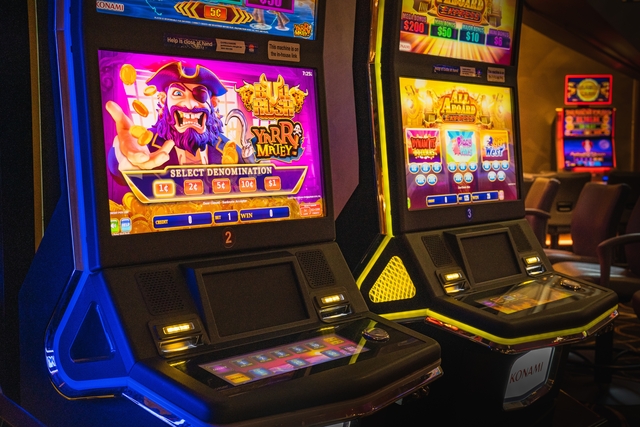
Council areas across Melbourne’s north-west continually record some of the highest gambling losses from Electronic Gambling Machines (EGMs), or poker machines, in Victoria. Advocates are calling on the state government to introduce measures to protect vulnerable people struggling with gambling addiction. Sam Porter reports.
Moving to Melbourne’s west was supposed to be a fresh start for Merapi and her husband.
After struggling with EGM addiction in their previous hometown of Auckland, the couple settled in Victoria to be closer to Merapi’s sister.
Once in Melbourne, Merapi noticed there were four gambling venues within a few-kilometre radius of her family’s new home.
“It doesn’t matter which way we went — north, south, east or west — there was a venue. We could even walk to some of them,” Merapi said.
“We found that the venues here were massive. We couldn’t believe it. Our gambling just grew and grew and we did try and stop but we just couldn’t.”
According to the state government, the social costs of gambling harm across the state were estimated to be $14.1 billion in 2023. In regions already experiencing social and financial disadvantage the impacts of gambling harm are much greater.
For Merapi and her husband, the high density of nearby poker-machine venues made it easy for them to gamble again.
“We were in the same place we were when we were in New Zealand, if not worse,” Merapi said.
As a result of gambling harm, the family was evicted from seven homes in 11 years, and Merapi and her husband had their cars repossessed. It affected the community around them, especially their children.
“The two older [kids] were jumping from school to school. There was no stability,” Merapi said.
“Living in poverty, that was our norm. I accepted that this was normal because I deserved it. Because I was the one that made these choices.”
Merapi said she hit rock bottom after she was caught tampering with money at her local sports club where she was working as the treasurer.
It was the turning point she needed to get better.
“We knew this was not our values. This is not how we were raised, but something about gambling and our pokies addiction drove us to become this way.”
Merapi and her husband decided to self-exclude from local gambling venues and sought professional help.
Merapi received free, confidential financial and therapeutic counselling from IPC Health over the course of three years.
“It (therapeutic counselling) changed my life. We have learned to celebrate the small things like staying in a house and not being evicted, like owning our own car, like making sure our children have stability in the schools they’re at,” she said.
“But it takes a lot. This is not an easy thing to overcome. You really need a village behind you.”
IPC Health community engagement officer Sarah-Jane Blunt is part of the organisation’s Gambler’s Help team.
She said EGMs are the most harmful products on the market.
“They’re designed to make people keep coming back for more because even when people have a near miss, with the sounds and the music and the lights that go off, their brain releases dopamine. So they’re still thinking that they’ve actually had that win when we know they haven’t,” Ms Blunt said.
Ms Blunt said communities are losing huge amounts of money from gambling harm.
“We’re losing more money because of all the financial impacts, the emotional psychological stress as well, the depression and suicide, relationships and domestic violence, and productivity.“
IPC Health chief executive Jayne Nelson said people start gambling for many reasons, including for entertainment or social connection, and sometimes to cope with stress, financial pressure or difficult life circumstances.
However, she said in many cases gambling harm is about environments rather than individual choices.
“Regions become gambling hotspots when there is a high concentration of poker machines, long trading hours, and venues located close to where people live, shop and socialise. Harm is much higher in communities experiencing financial stress or disadvantage,” Ms Nelson said.
“In Melbourne’s west, we see all these factors come together.”
According to the Victorian Gambling and Casino Control Commission, the City of Brimbank has led in EGM losses statewide for more than a decade now.
In the 2024-25 financial year, more than $175 million was lost to the 953 EGMs in the municipality — an average loss of $1129 per adult.
Brimbank ranks in the bottom ten per cent of council areas in Victoria on the 2021 SEIFA Index of Relative Socio-Economic Disadvantage, with a score of 912.
The council area’s unemployment rate is also higher than the state average.
“There’s a statistical correlation between unemployment and gambling loss,” Ms Nelson said.
To reduce gambling harm in hotspot regions, Ms Nelson said measures should be taken to lower the number of EGMs in high-loss areas and introduce mandatory pre-commitment systems to allow people to set safe gambling limits.
“Reducing gambling harm requires systemic change, not just individual effort,” she said.
Alliance for Gambling Reform (AGR) chief advocate Tim Costello agrees.
He said the state government should mandate compulsory cashless cards that allow people to set their own loss limits, as voluntary use of such cards is not enough.
“You’re locking in your losses saying ‘I can’t afford to lose more than $200’ and then you are locked out for the time you designated… It might be 24 hours or a week,” Mr Costello said.
The initiative was recommended by the 2010 Productivity Commission Inquiry into gambling.
“You give people the right to still gamble and give them a proven method to safeguard them because we know once in front of the machine you will lose all track of time,” he said.
The state government said it’s investing more than $41 million to prevent and address gambling harm, including increased funding for the Gambler’s Help program.
“We’ve also slowed spin rates on new machines [and] reduced the cash load limit to $100 to prevent and address gambling harm across Victoria,” the spokesperson said.
According to the state government’s 2025-26 budget, 81.5 per cent of the estimated $2.7 billion gambling tax revenue will go towards the Hospitals and Charities Fund, the Mental Health Fund, and the Community Support Fund, leaving the remaining 18.5 per cent as direct revenue.
The state government also recently trialled the mandated cashless ‘YourPlay’ card in Monash, Ballarat and Greater Dandenong council areas.
The trial ended on 30 November with its evaluation to commence soon, the state government said.
However, the AGR criticised the trial for its lack of engagement with local councils and for not including a mandatory, binding loss limit feature.
As a result, Monash council withdrew its initial support of the trial.
In a joint letter signed by members of the AGR and 13 Victorian councils including, Brimbank, Wyndham and Maribyrnong, representatives expressed their dissatisfaction with the trial and called on the state government to meet to discuss gambling reforms.
Today, Merapi and her husband are well-supported by the people around them.
Merapi offered advice to her younger self.
“I would say to her to understand that gambling, it doesn’t discriminate. It doesn’t actually care. It has no sense of family, has no sense of self or culture…nothing” she said.
Merapi, a respected community leader, works as the manager for Life Community Kitchen in Melbourne’s west.
The organisation provides thousands of free meals each year to disadvantaged locals.
“I knew that I was called for greater things. It was just delayed, but I got there in the end.“
Gambler’s Help Victoria: 1800 858 858 (24 hours)
IPC HEALTH (Brimbank, Hobsons Bay, Maribyrnong and Wyndham): 7037 2104 or email gamblershelp@ipchealth.com.au