The federal government officially welcomed home the athletics from the 1980 Olympics Games in Russia on July 30, 45 years after the Games. Tara Murray chats with David Smith, who was among those to compete at the Games despite Australia’s boycott.
There was no way that David Smith was going to miss out on representing Australia at the 1980 Olympics.
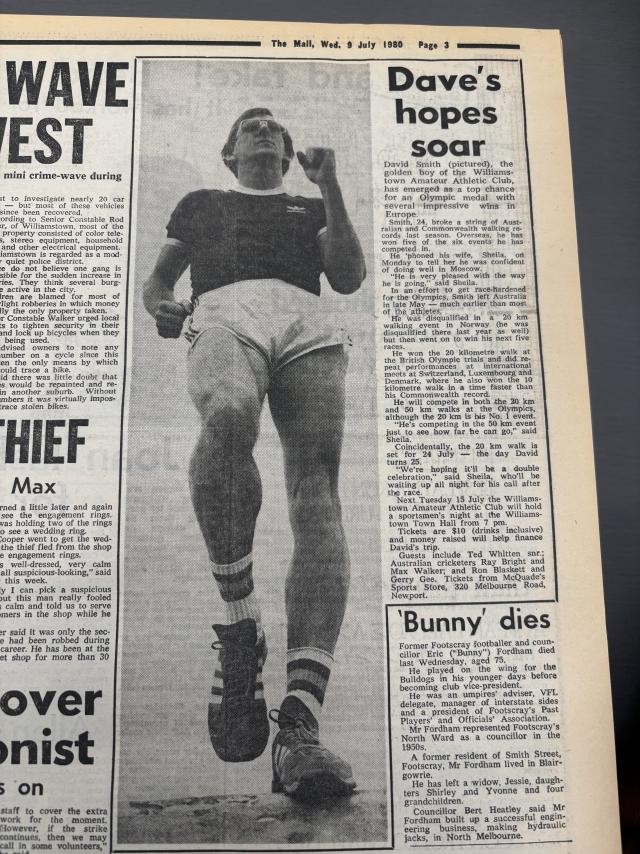
The race walker from the then Williamstown Athletics Club had five qualifying times to compete on the biggest stage for the first time.
While Smith was keen to hit the track in Moscow, there were bigger things going on behind the scenes.
More than 45 countries boycotted the Games in protest of the Soviet Union’s invasion of Afghanistan in December 1979.
There was intense pressure from the Australian government and many sporting administrators and commentators for local athletes to boycott the Games.
Some athletes snuck out of the country, others decided not to go at all.
Smith was unaware of a lot of the drama back home in the lead up to the Games, having spent the three months before the Games competing in Europe.
“Forty-five years ago I didn’t know that we were rejected and not acknowledged,” he said.
“I knew there was a boycott going on and they asked me to go on the Peter Couchman Show, which is one of those personality shows.
“They asked me, ‘are you going to support the boycott? I said no way.
“I had my ticket to Europe and the visa to get into the Games, even if the team didn’t turn up … I was still going.
“I would have walked under the neutral flag and competed under the natural flag if that was the case.”
Smith had his own concerns heading into the Games. He found himself in Europe with no money and his Euro pass expired before meeting up with the Australian team.
He jumped on a train late at night in Belgium without a ticket and reached out to a real estate agent to send him money so he could meet up with his teammates.
Smith had given up work to train full-time for the year before the Games and was one of the first people named on the team.
He said the Olympic Games experience was amazing.
“I had the best time of all,” he said. “Totally enthralled with it. There was no way I would miss out marching in the Olympic Games opening ceremony.
“It was the best feeling of all time.”
Smith was later disqualified in the 20-kilometre walk event
After the Games, Smith continued to compete and travel through Europe for three months.
The 1980 event would be one of two Games that Smith would compete in.
He finished 10th four years later at the Los Angles Games.
Smith said he entered the event in good shape having won a 10-kilometre event weeks beforehand.
“The only problem we had was the heat and humidity, we were all done sweating by seven kilometres as it was that dry,” he said.
“I pushed through. Theoretically on times and everything, I should have been one of the top contenders.”
While Smith made his name in athletics, it wasn’t his first sporting love.
He was an amateur boxer with more than 50 fights under his belt and also played rugby league.
It was a move to Werribee that set him onto the path to the Olympics.
“When I came down from Darwin in year 12, I joined Werribee Athletics Club. In Darwin I was playing rugby league and my dad was the Australian lightweight boxing champion in his time.
“He was teaching me boxing. I was also riding track work with the horses.
“Dad got posted to Point Cook. There were no horses, no boxing and no rugby league.”
Having had some success at the NT Walkabout event in the Northern Territory, had got stuck into athletics when he moved to Werribee.
One of his classmates was a race walker and he quickly joined the ranks as a junior and won two 10-kilometre titles in his first year.
He jumped into the senior ranks and moved to Footscray Athletics Club and then to Williamstown as it was ranked as a higher level club. He still holds four club records at Williamstown.
“I was running out of competition and running out of venues, as I was getting quicker and quicker,” he said.
“I joined Williamstown as an A-grade club and spent a whole heap of time there. They were brilliant, one of the nicest groups of guys in a club that you can imagine.”
Smith later turned coach and started helping the next generation of race walkers.
Among them was his son Dane Bird-Smith.
It would take Smith back to the Olympics again.
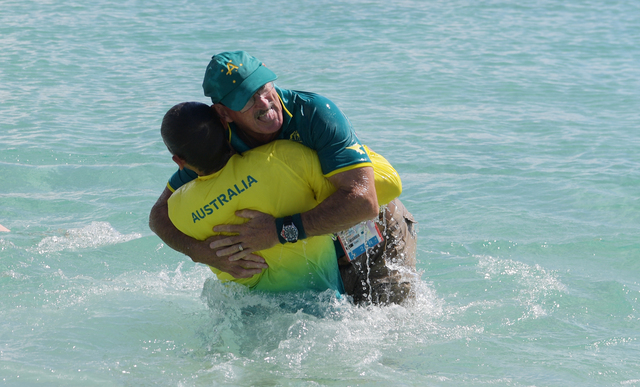
In 2016, Smith watched on as his son won Olympic bronze in the 20-kilometre walk.
“I took him around the world [to] exactly the same series of races I had raced 33 years beforehand,” he said.
“He mirrored a lot of the races that I had done.
“He pretty much broke all my Australian records on his way through.
“His bronze medal in Rio was absolutely brilliant. It was superb. I get the kudos of being his coach.
“He tells me he’s a far better athlete than me … I just told him he had a far better coach than I did. I was self coached.”
Smith, who recently turned 70, still loves the sport. He coached in several different countries but has now retired.
Living in Queensland, he is enjoying the sailing life.
Smith wasn’t at the welcoming home last week, due to already having committed to dog-sitting duties for his son.
Smith said competing at the Olympics has been a special memory.
“Once an Olympian, always an Olympian, that’s our catch cry,” he said.
“I don’t think there’s many people in Australia that appreciate what it takes to become an Olympian.”