A Werribee man has sung the praises of a new technology that saved his life when he suffered from a stroke earlier this year.
John Delaney, 74, was enjoying a quiet evening at home in Werribee on March 22 when he became unwell suddenly.
His wife, Margaret, recognised the signs of stroke and immediately called triple-0.
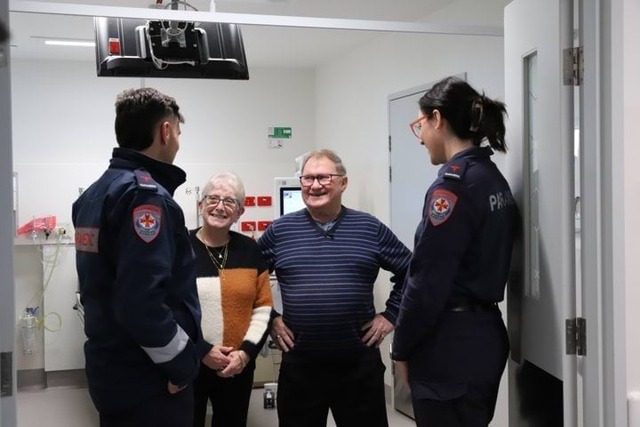
Paramedics arrived, identifying that the great grandfather was experiencing a stroke and took him to Werribee Mercy Hospital.
He initially received a Victorian Stroke Telemedicine (VST) consultation in the emergency department and subsequently became the first patient to benefit from the service in the hospital.
The Victorian Telestroke Inpatient Service (VTIS) is a system that gives stroke patients direct access to Ambulance Victoria’s team of stroke specialists and neurologists via telemedicine.
Since launching at Werribee Mercy Hospital in March, 118 patients have benefited from VTIS – many of whom would have required ambulance transfer to a larger hospital for specialist care.
The model delivers timely diagnosis, tailored management and coordinated discharge planning – all in one place.
Mr Delaney said the treatment being so close to home made his ordeal much easier to get through.
“Receiving all my care in Werribee was brilliant. It’s close to home and I was extremely happy with the service,” he said.
“Everything worked in my favour.”
The hospital’s director of medicine Peter Lange said the VTIS partnership has been a fantastic addition to the services they can offer patients.
“It complements the expertise of our own on-site stroke physicians, ensuring patients receive the highest standard of care close to home,” he said.
Werribee Mercy hospital executive director Brad Van Ooi said delivering a successful health service relies on continually evolving and strengthening partnerships.
“Our community is growing rapidly and so are the services we provide,” he said.
“Initiatives like VTIS reflect our commitment to providing exceptional care within our local area, where it matters most.”
The VTIS improves diagnostic accuracy, reduces duplication of services and is cost effective for local health services.
In 2023, only 35 per cent of regional stroke survivors received formal stroke unit care.
AV encourages Wyndham locals to familiarise themselves with the F.A.S.T. stroke signs (face, arms, speech, time).